
If you're a mental health provider looking to expand your practice by getting in-network with insurance companies, you've probably heard the word "credentialing" thrown around. Maybe you've even started the process and immediately felt like you'd stumbled into a bureaucratic nightmare.
Here's the truth: credentialing is essential if you want to accept insurance, but it doesn't have to be the headache everyone makes it out to be. Let's break down what it actually involves, what you need to prepare, and why handing this beast off to someone who does it for a living might be the smartest business decision you make this year.
What Is Credentialing, Anyway?
Credentialing is the process of becoming an approved, in-network provider with insurance companies. Think of it as your formal introduction to insurance panels, you're essentially proving you're qualified, licensed, and trustworthy enough to treat their members and get paid directly by them.
Without credentialing, you're stuck being an out-of-network provider. That means your clients have to pay you upfront and chase reimbursement themselves (if their plan even covers out-of-network care). Not exactly a patient-friendly setup, and it can seriously limit your practice growth.
The catch? You can't just apply once and magically get credentialed with every insurance company. You have to apply to each insurance panel separately, and each one has its own application process, requirements, and timeline. It's like filling out college applications all over again, except with way more paperwork and no campus tours.
The Documentation Mountain: What You'll Need
Before you even think about submitting your first application, you need to gather a mountain of documents. And we're not talking about a quick scan of your driver's license, this is the real deal.
Core Documents Everyone Needs
- Professional license(s) for every state where you practice (current and active)
- National Provider Identifier (NPI) number (if you don't have one yet, get it from the NPPES)
- Five-year work history with explanations for any employment gaps longer than six months
- Education and training documents: degrees, transcripts, certificates
- Board certifications relevant to your mental health specialty
- Current malpractice insurance documentation
- CV or resume (updated, professional, and comprehensive)
- Tax ID information and W-9 form
- Practice information: addresses, phone numbers, service locations
Specialty-Specific Requirements
Here's where it gets tricky. Your specific credential type determines additional requirements:
Psychiatrists need DEA registration (since you can prescribe) and documented evidence of completed psychiatry residency.
LCSWs, LMFTs, and LPCs need their respective state licenses and continuing education documentation proving you're staying current in your field.
Applied Behavior Analysis providers must hold clear board certification (BCaBA, BCBA, or BCBA-D) through the Behavioral Analyst Certification Board.
The requirements vary significantly depending on your specialty and the states where you're practicing. If you work across multiple state lines (hello, telehealth!), you'll need to organize everything by jurisdiction because what flies in New York might not cut it in Florida.

The Credentialing Process: Step-by-Step
Alright, you've got your documents. Now what?
Step 1: Register with CAQH ProView
Start here. Seriously. CAQH ProView is a centralized database that most insurance companies use for credentialing. Instead of sending the same information to twenty different insurers, you build one comprehensive profile that they can all access.
Create your profile, upload all required documentation in the specified formats (yes, they're picky about PDFs versus JPEGs), and authorize access for each insurance company where you're applying.
Pro tip: CAQH requires you to "re-attest" every 120 days, which basically means logging in and confirming everything is still accurate. Set a calendar reminder, or your profile goes inactive and you're back to square one.
Step 2: Submit Individual Applications
Here's the part that surprises people: CAQH doesn't do the credentialing for you. It just stores your information. You still have to apply to each insurance company separately.
Each insurer will pull your CAQH data, but they'll also have their own application forms, contracts to sign, and additional questions to answer. And each one takes several weeks to process, sometimes longer if they're backlogged or if something in your application needs clarification.
Step 3: Wait (and Wait Some More)
The standard credentialing timeline is anywhere from 60 to 120 days, depending on the insurer and how complete your application is. During this time, insurance companies are verifying everything: contacting your previous employers, checking your license with state boards, reviewing your malpractice history, and making sure you didn't fudge anything on your application.
If they find discrepancies or missing information, the clock resets while you scramble to provide clarifications.
Common Pitfalls (and How to Avoid Them)
Even with the best intentions, providers trip up during credentialing. Here's what to watch out for:
Starting too late. If you're opening a new practice or adding a new insurance panel, don't wait until you're ready to see patients. Start the credentialing process months in advance, you can't bill insurance until you're fully credentialed, which means zero revenue during the waiting period.
Incomplete applications. Missing even one document can delay your entire application by weeks. Insurance companies aren't going to chase you down for that missing transcript, they'll just let your application sit in limbo.
Outdated CAQH information. If your license renewed, you moved offices, or your malpractice insurance changed, update CAQH immediately. Outdated information flags your application and creates unnecessary delays.
Paper applications. Some providers still try to mail paper applications instead of applying online through CAQH. This is slower, more error-prone, and frankly, nobody wants to deal with paper anymore.
Why Outsourcing Credentialing Makes Sense
Let's be real: you didn't become a therapist to spend hours filling out insurance forms. You got into mental health to help people, not to navigate bureaucratic mazes.
Credentialing is time-consuming, detail-oriented, and requires constant follow-up. It's also critically important, mess it up, and you're looking at delayed revenue, frustrated patients, and a whole lot of stress.
That's where outsourcing comes in.
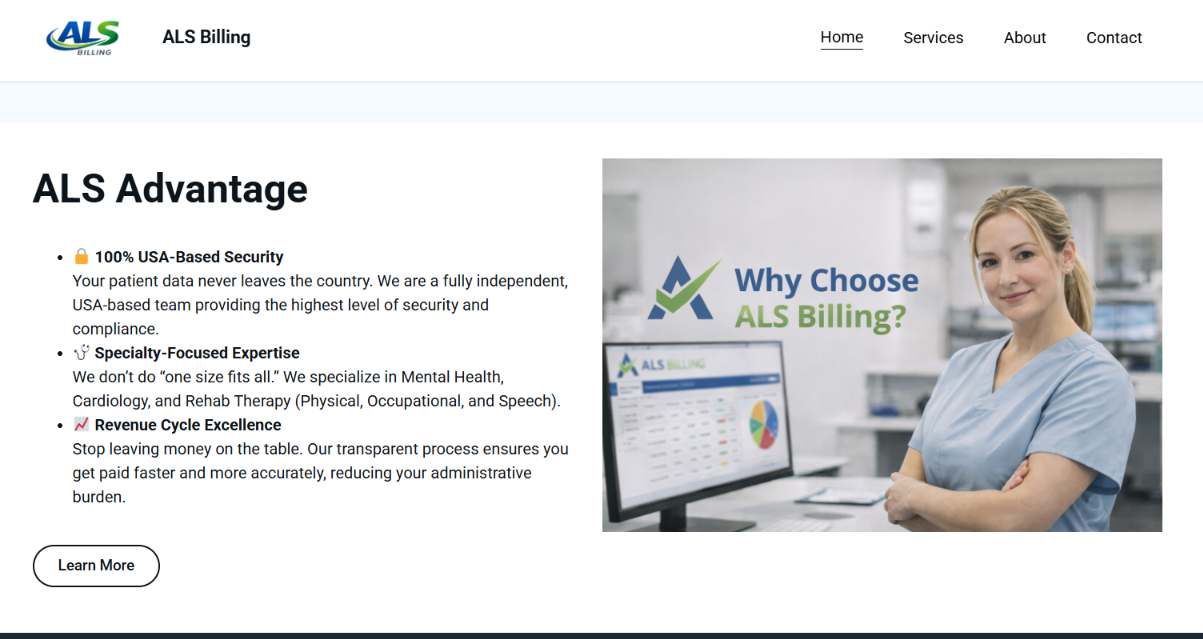
When you work with a 100% USA-based medical billing company like ALS Billing, you're not just handing off paperwork, you're partnering with experts who do this every single day. We know exactly what each insurance company requires, how to avoid common delays, and how to follow up effectively when applications stall.
What Professional Credentialing Support Looks Like
A credentialing specialist will:
- Gather and organize all your documentation so nothing slips through the cracks
- Complete applications accurately the first time (no back-and-forth with insurers over missing signatures)
- Track deadlines and re-attestation dates so your credentials stay active
- Follow up with insurance companies when applications are delayed
- Handle re-credentialing when licenses renew or information changes
For mental health providers, there's an added bonus: privacy and security matter more in your field than almost anywhere else. Working with a USA-based billing partner means your patient information and credentials stay within U.S. borders, protected by HIPAA and handled by professionals who understand the sensitivity of behavioral health data.
The Bottom Line
Credentialing doesn't have to be a headache. Yes, it's detailed work. Yes, it takes time. But with the right preparation: or the right partner: it becomes just another box to check on your path to building a thriving practice.
If you're drowning in paperwork or just want to get back to what you actually love doing (helping people, not filing forms), it might be time to bring in the experts. At ALS Billing, we handle mental health credentialing every day, and we'd love to take this particular burden off your plate.
Ready to get in-network without the stress? Reach out to us( we'll take it from here.)