If you're running a mental health practice, you already know your patients' trust is everything. They're sharing their most vulnerable moments with you: anxiety, depression, trauma, family struggles. The last thing they should worry about is whether their billing information is secure or if their insurance claims are being handled with care.
Here's the thing: not all medical billing services are created equal, especially when it comes to mental health. And when you're dealing with something as sensitive as behavioral health records, where your billing partner is located actually matters. A lot.
Let's talk about why choosing a USA-based billing service isn't just a nice-to-have for mental health providers: it's a must-have.
The Security Factor: HIPAA Isn't Optional
Mental health records are some of the most protected data in healthcare, and for good reason. Your patients aren't just sharing their blood pressure readings: they're sharing details about suicidal ideation, substance abuse, relationship problems, and childhood trauma.
When you outsource billing overseas, you're essentially sending that sensitive information across international borders where US privacy laws don't apply. Sure, a company might say they're HIPAA-compliant, but enforcing those standards gets murky when servers and staff are located in countries with different data protection laws.
USA-based billing services operate under strict HIPAA regulations with real legal accountability. If there's a breach, there are consequences. Clear ones. Your patients deserve that level of protection, and honestly, so does your practice. One data breach can destroy years of trust-building and put your entire practice at risk.
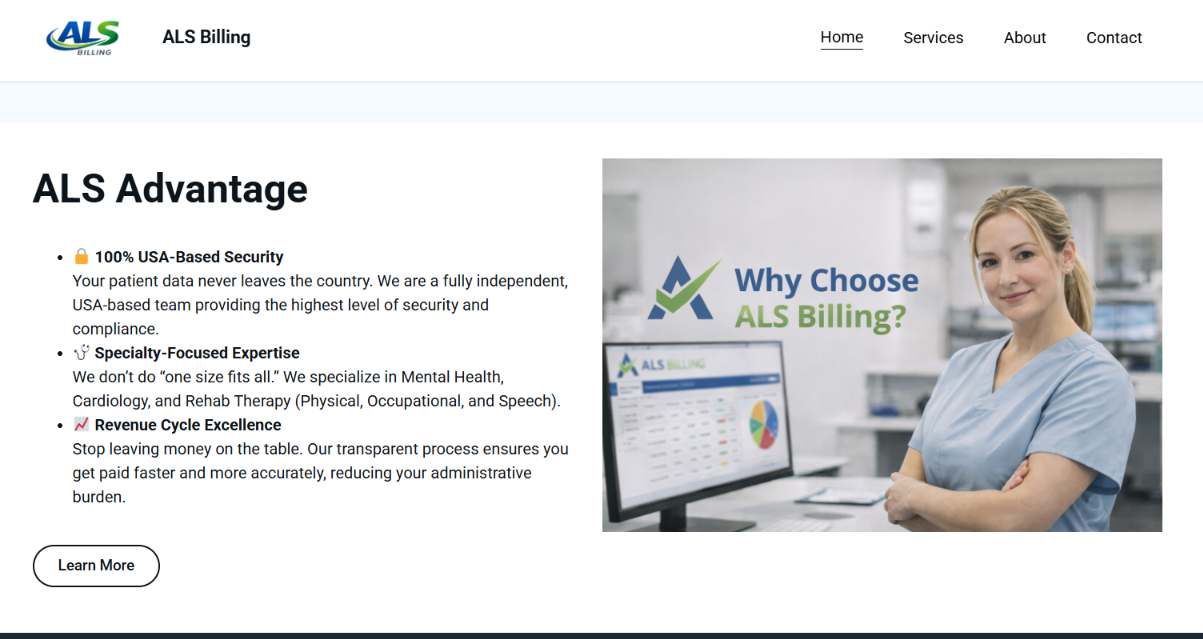
At ALS Billing, we're 100% USA-based: from our servers to our staff. That means every claim, every patient record, every piece of data stays within US jurisdiction where HIPAA enforcement is strong and consistent.
The Sensitivity Factor: Mental Health Billing Isn't Generic
Here's something that often gets overlooked: mental health billing is different. The codes are different. The documentation requirements are different. The denial reasons are different. And the stakes feel different because your patients are already vulnerable.
Think about it: when a therapist submits a claim for CPT code 90834 (a 45-minute therapy session), that billing partner needs to understand not just the code itself, but the nuances around it. Did the provider document medical necessity correctly? Was the session conducted via telehealth, and if so, does that state require a specific modifier? Is this patient seeing the therapist for an ongoing condition that needs updated documentation every 90 days for Medicaid?

A USA-based billing team understands these intricacies because they're living and breathing the American mental health insurance landscape every single day. They know that some states require live supervision documentation for certain therapy codes. They understand the Mental Health Parity and Addiction Equity Act (MHPAEA) and how it affects coverage determinations. They can distinguish between the different requirements for Medicare, Medicaid, and commercial payers without missing a beat.
When your billing service truly gets the complexity of mental health claims, you see fewer denials, faster payments, and less stress. Your patients get better continuity of care because their sessions aren't getting interrupted by insurance snafus.
The Speed Factor: Regulations Change Constantly
Let's be real: healthcare regulations change faster than most of us can keep up with. New CPT codes drop. Medicare updates its guidelines. States tweak their Medicaid requirements. Payers shift their policies seemingly overnight.
In 2025 alone, we saw significant updates to mental health billing codes and telehealth requirements. When your billing partner is USA-based, they're catching those changes in real-time. They're reading the CMS updates the day they drop. They're attending the webinars. They're on the listservs. They're here, in the same regulatory environment you are.
Compare that to an offshore billing service that might have a 12-hour time difference and needs to coordinate updates across international teams. By the time they implement a new regulation, you could already be facing claim denials.
Speed also matters when problems arise. If a claim gets denied or a payer has questions, you need someone who can pick up the phone during business hours (your business hours, not someone else's time zone) and sort it out immediately. Mental health providers often work with patients who are in crisis or need continuous care: delays in payment processing can directly impact your ability to keep your doors open and your schedule full.
State-by-State Expertise: It's Not One-Size-Fits-All
Here's something that catches a lot of mental health practices off guard: billing rules vary wildly from state to state. What works in California might get you denied in Texas. Florida's Medicaid requirements look nothing like New York's.
Some states require documentation updates every 90 days for mental health Medicaid claims. Others have specific rules around how you bill for group therapy versus individual therapy. Telehealth modifiers? Those can differ depending on where your patient is located, not just where you're practicing.
A USA-based billing service: especially one that specializes in mental health: already knows these state-specific landmines. They've navigated them hundreds of times before. They know which states are sticklers for certain documentation elements and which payers are most likely to deny claims for seemingly arbitrary reasons.

At ALS Billing, we've built our entire model around specialty-focused expertise, which means when we handle mental health billing, we're not treating it like any other medical claim. We know the landscape. We know the pitfalls. And we know how to get you paid faster and more consistently.
Communication That Actually Works
Let's talk about something practical: communication. When your billing service is in the same country: operating during the same business hours, speaking the same cultural language, understanding the same healthcare frustrations: everything just works better.
You can call during your lunch break and actually reach someone. You can send an urgent email at 2 PM and get a response before the end of the day. You're not waiting until midnight for someone on the other side of the world to wake up and check their messages.
This matters especially in mental health, where billing questions can be time-sensitive. If a patient calls asking about their claim status because they're worried about affording their next session, you need answers now, not in 12-18 hours.
The Bottom Line: Your Practice Deserves Better
Mental health billing isn't something to outsource to the lowest bidder. It's not a commodity service where "close enough" is good enough. Your patients are trusting you with their mental health, and you need to trust your billing partner with their data, their privacy, and ultimately, your practice's financial health.
Choosing a USA-based billing service means:
- Real HIPAA compliance with legal accountability
- Specialty expertise in mental health's unique coding and documentation requirements
- Real-time updates when regulations change
- State-specific knowledge that prevents costly denials
- Communication that works in your time zone, in your language, with your cultural context
At ALS Billing, we're not just USA-based: we're specialty-focused. We understand that mental health billing requires a different level of care, sensitivity, and expertise. Your patients deserve that level of protection, and your practice deserves that level of support.
If you're tired of dealing with billing headaches, denied claims, and overseas partners who don't quite "get" the complexity of mental health billing, let's talk. We'd love to show you what a truly specialized, USA-based billing partnership can do for your practice.