Let’s be honest: no one goes to dental school because they have a passion for paperwork. You’re there to transform smiles, relieve pain, and improve your patients' oral health. But as any practice owner knows, the "business" side of dentistry, specifically billing, can quickly turn into a headache that even the strongest local anesthetic can’t numb.
With the arrival of 2026, the American Dental Association (ADA) has introduced significant updates to the Current Dental Terminology (CDT) codes. Staying compliant isn't just about following rules; it’s about ensuring your practice gets paid fairly and promptly for the hard work you do. At ALS Billing, we see the behind-the-scenes struggles practices face every day. Whether you are a general dentist, an orthodontist, or expanding into multispecialty care, avoiding these seven common CDT coding mistakes is the key to a healthy bottom line.
1. Relying on Truncated Software Descriptions
One of the most frequent mistakes we see is "coding by the drop-down menu." Most dental practice management softwares truncate the full nomenclature and descriptors of CDT codes to save space.
If you're just clicking the first thing that looks "close enough," you’re likely miscoding. The CDT 2026 manual contains specific definitions that determine when a code is applicable. For example, if you rely on a short description for a restorative procedure, you might miss a crucial detail about the number of surfaces or the specific material required to justify that code.
How to Fix It: Always refer back to the full CDT manual for any code you aren't 100% sure about. Code for what you actually did, not what the software suggests. If you’re feeling overwhelmed by the nuances, remember that having a professional medical billing service can take this weight off your shoulders.
2. The "Unbundling" Blunder
In the eyes of insurance payers, "unbundling" is a major red flag. This happens when a practice bills for several individual procedures that should actually be covered under a single, comprehensive code.
A classic example is billing for suture removal separately after an extraction. In most cases, the extraction code includes the necessary follow-up care, such as removing sutures. Another common error is trying to bill for pins separately when they are already included in a core buildup code.
How to Fix It: Familiarize yourself with "bundled" services. If a step is a standard part of a larger procedure, it usually isn't billable on its own. Our 100% USA-based team at ALS Billing specializes in catching these overlaps before they reach the insurance company, preventing potential audits and "red flag" status.
3. Upcoding and Downcoding (The Goldilocks Problem)
Finding the "just right" code is harder than it sounds.
- Upcoding: Selecting a code for a more complex (and expensive) procedure than what was performed. (e.g., billing a complex surgical extraction for a simple one).
- Downcoding: Selecting a simpler code, often out of fear that a higher code will be denied.
Both are dangerous. Upcoding can lead to fraud investigations, while downcoding leaves money on the table that you rightfully earned. We often see practices billing D4341 (scaling and root planing) for what is essentially a routine adult cleaning (D1110) because the patient had a bit of inflammation. If the clinical markers for periodontal disease aren't there, it’s a mistake.
How to Fix It: Use the code that exactly matches the clinical documentation. If you find yourself consistently "rounding up" or "rounding down," it’s time to review your clinical protocols.
4. Failing the "Medical Necessity" Test
In 2026, insurance companies are more scrutinized than ever regarding what they pay for. They aren't just looking for what you did; they want to know why you did it. If your clinical notes don't clearly state the rationale for a procedure, the claim is likely to be rejected.
This is especially true for orthodontists and those performing oral surgery. If you aren't documenting the clinical findings that justify a specific treatment, the insurance company will deem it "cosmetic" or "elective" and deny payment.
How to Fix It: Your clinical notes must be the star of the show. Mention the patient’s symptoms, the diagnostic results, and why the specific CDT code selected was the only viable path forward. If you're struggling with how to document correctly, check out our guide on why documentation is an audit magnet.
5. Ignoring the CDT 2026 New and Deleted Codes
The ADA doesn't keep things static. For 2026, there are 31 new codes, 14 revised codes, and 6 deleted codes. If your billing team is still using codes that were retired on December 31, 2025, your claims will be rejected instantly.
New codes often cover emerging technologies or more specific types of preventative care. Ignoring these means you're not using the most accurate language available to describe your work.
How to Fix It: Ensure your practice management system is updated as of January 1 each year. More importantly, ensure your billing staff (or your outsourced partners) have undergone training on the specific changes for 2026. At ALS Billing, we stay ahead of these curves so you don’t have to.
6. Modifier Madness
While modifiers are more common in medical billing (CPT codes), they are increasingly relevant in dental billing, especially when dealing with dual-coverage or medical-cross-coding for procedures like sleep apnea appliances or certain oral surgeries.
Using an incorrect modifier, or forgetting one when it’s required to show that a procedure was performed on a distinct site, will lead to a denial. This is where many dental offices get tripped up, especially those who aren't used to the rigors of medical-grade billing.
How to Fix It: If your practice is expanding into areas like Optometry or Orthodontics, the complexity of modifiers increases. This is why a USA-based touch is so important; you need someone who understands the nuances of local payer requirements.

7. The Documentation Gap (If It’s Not Written, It Didn’t Happen)
This is the "golden rule" of billing. You could perform the most perfect crown preparation in history, but if your notes don't reflect the specific tooth, the surfaces, the material, and the condition of the tooth prior to treatment, it’s as if it never happened in the eyes of the insurer.
Common gaps include:
- Missing tooth numbers or quadrants.
- Lack of "start and stop" times for anesthesia.
- Failing to mention the "why" (as mentioned in point 4).
How to Fix It: Audit your own notes once a month. Pick five random claims and see if a stranger (like an insurance adjuster) could understand exactly what happened just by reading your notes. If the answer is no, your practice is at risk.
Why ALS Billing is the Right Partner for Your Dental Practice
Expansion is exciting. Whether you are adding an orthodontist to your team or incorporating optometry services into a multi-disciplinary health center, your billing needs to keep pace.
At ALS Billing, we pride ourselves on being more than just a "service." We are an extension of your team.
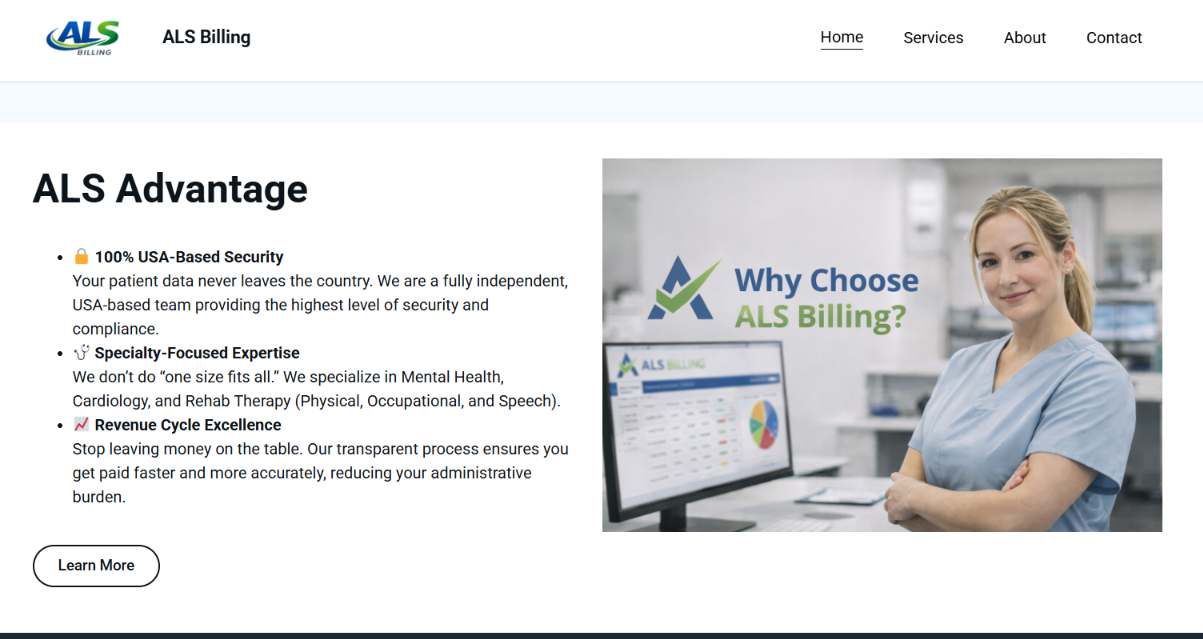
- 100% USA-Based: We don't outsource your sensitive patient data overseas. Our team is right here, understanding the American healthcare landscape.
- Accuracy and Compliance: We specialize in the "tricky" stuff: the codes that change, the modifiers that confuse, and the documentation that protects you.
- Specialty-Specific Expertise: From mental health to rehab therapy and now Dentistry and Orthodontics, we know the "language" of your specialty.
Take the Stress Out of Your Revenue Cycle
The mistakes listed above are common, but they aren't inevitable. By tightening your coding habits and ensuring your documentation is airtight, you can significantly reduce denials and increase your practice's cash flow.
However, we know you're busy. You have patients to see and a practice to run. If you're tired of fighting with insurance companies over CDT 2026 codes, let us handle the heavy lifting.
Ready to see how ALS Billing can transform your dental or specialty practice? Explore our Learning Center for more tips, or contact us today to learn how our USA-based experts can streamline your billing process.
Getting paid correctly shouldn't be a struggle. With the right codes and the right partner, you can focus on what you do best: keeping your patients healthy and smiling.